

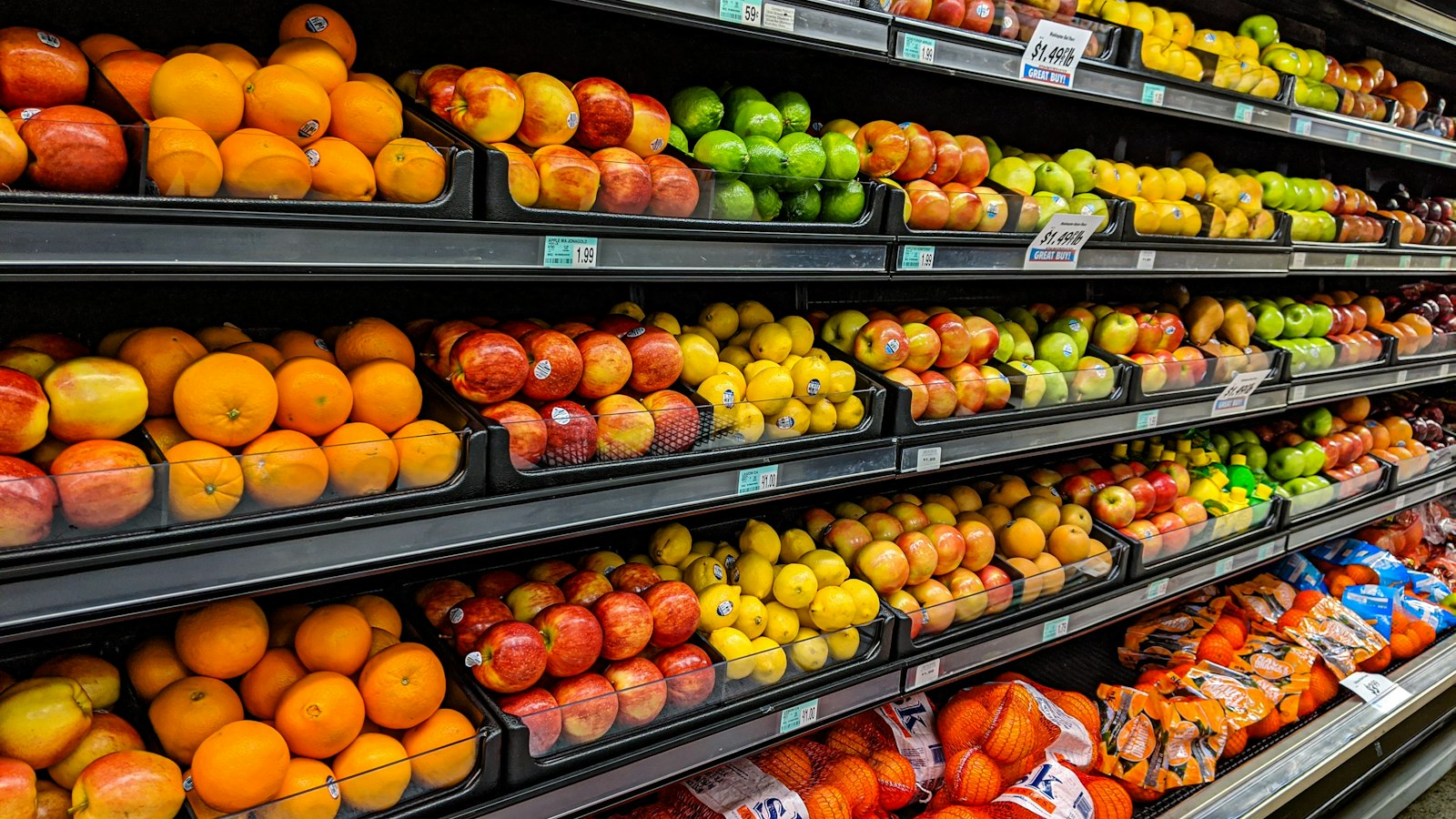
- Switzerland generates around 2.8 million tonnes of avoidable food losses a year. The federal government aims to halve them by 2030.
- Food past its best-before date may be sold if it is in perfect condition and nobody is misled. Food past its use-by date may not.
- Studies show that reducing prices early and step by step cuts waste and can improve margins.
- Since 2025, simplified rules for reference prices apply in Switzerland. They should be built into any automated pricing.
The situation in Switzerland
According to the Federal Office for the Environment (FOEN), Swiss consumption causes around 2.8 million tonnes of avoidable food losses a year. That was around 330 kilograms per person in 2017 and 310 kilograms in 2024. In 2022, the Federal Council adopted an action plan to halve these losses by 2030, and companies and associations signed an industry agreement in the same year.[1]
Around 10 % of losses occur in wholesale and retail, most of them in processing and households.[2, 20] The 2025 monitoring shows progress: across the whole chain, losses fell by around 5 % since 2017, and by around 20 % in retail. Reaching the 2030 target is nevertheless considered very unlikely.[3]
For retailers, this is not only an environmental issue. Every written-off item is lost margin, and capital tied up in stock costs money. In practice, inventory carrying costs are often estimated at 20 to 30 % of inventory value per year.[15] That is a common rule of thumb rather than a fixed value, but it shows the order of magnitude.
What Swiss food law allows
Date marking is governed by the FDHA Ordinance on Food Information (LIV). As a rule, a best-before date must be given. For microbiologically highly perishable foods, a use-by date is required instead. Some products, such as fresh fruit and vegetables, are exempt.[4]
- After the best-before date, food may still be sold if quality and safety are guaranteed and consumers are not misled. The business is responsible for this.[5]
- After the use-by date, food may no longer be sold.[5]
- Guide values: depending on the category, the FSVO gives periods for selling after the best-before date, from a few days for small baked goods and pasteurised milk to around one year for pasta.[5]
With information letter 2025/4.1 dated 01.09.2026, the FSVO published new guidance on selling food after the best-before date and freezing food before the use-by date.[6] Before implementing anything, check whether periods or labelling requirements have changed for your products.
For automated pricing, this means products with a use-by date need a hard limit after which they can no longer be sold. Products with a best-before date can be reduced in stages and, if their quality is perfect, still be offered after the date, provided this is clearly indicated.
Price law: stating reference prices correctly
A revised Price Indication Ordinance (PBV) has applied in Switzerland since 1 January 2025. For self-comparison, meaning a reference to your own previous price, sellers can choose between two rules:[7, 8]
- Previous rule: the earlier price may be shown for half as long as it applied, for a maximum of two months.
- New rule: the earlier price may be shown without a time limit, even with further reductions, if the goods were actually offered at that price for at least 30 consecutive days beforehand.
Sellers must be able to prove that the reference price actually applied. Automated pricing should therefore store the price history for each item. Whether special rules apply to perishable goods should be clarified case by case.
If you also sell to Germany, the German Price Indication Ordinance applies there. Under § 11 PAngV, a price reduction must state the lowest price of the previous 30 days. In 2024, the Court of Justice of the EU confirmed that a discount must refer to this price (C-330/23).[9, 10] There is an exception for highly perishable goods or goods with a short shelf life if the price is reduced because of impending spoilage and this is indicated.[9]
What dynamic pricing achieves
Research on dynamic pricing for perishable goods is clearer than on many other topics. A study by Robert Sanders (UC San Diego), published in Marketing Science, examined bread at a US supermarket chain. Dynamic prices reduced waste by at least 21 % and increased gross margin by 3 %.[11, 12]
A simulation model by Haijema and colleagues in the International Journal of Production Economics (2026) tested discounts in the last two days before expiry. The result: 3.8 % more profit, and the share of spoiled goods fell from 5.6 % to 3.6 %.[13] McKinsey reports that analytically managed markdowns in retail typically improve markdown margin by 4 to 8 %, with first results after 12 to 14 weeks.[14]
Reducing early and in small steps sells more goods at a still good price. Reducing late and heavily gives away margin or ends in write-offs. An automated system can make this decision for every item several times a day, which is hardly possible by hand.
How rule-based automated pricing works
A good solution does not decide on gut feeling, but on clear data and limits:
- Capture data: best-before or use-by date per batch, end of season, stock and sales velocity so far.
- Forecast sell-through: is the current pace enough to sell the stock in time?
- Define stages: reductions in small steps, with a minimum price and maximum discount per item.
- Recalculate regularly: for example twice a day, so that prices respond to actual sales.
- Raise prices again: if an item sells faster than needed, the discount can shrink.
- Stay within the law: reference prices according to the PBV, stored price history, use-by date as a hard limit.
- Label transparently: show short dates or the end of the season in the shop.
Implementation in Shopify and WooCommerce
| Topic | Shopify | WooCommerce |
|---|---|---|
| Sale price | Original price in «Compare-at price», reduced price in «Price»[16] | Fields regular_price and sale_price[18] |
| Scheduling | The Shopify Help Center does not mention built-in scheduling[16] | date_on_sale_from and date_on_sale_to, run via WP-Cron[18, 19] |
| Bulk changes via API | GraphQL mutation productVariantsBulkUpdate[17] | REST API, including batch requests |
| Pitfall | Fixed prices per market override these values[16] | Discount plugins that calculate at runtime do not appear in the sale filter[19] |
Both systems need external logic that knows shelf life and sales data, calculates prices and writes them back via the API. The best-before date per batch is usually not available in standard shops and has to come from the warehouse or ERP system.
Frequently asked questions
May I sell food after its best-before date?
How long may I show a crossed-out price?
Is dynamic pricing worthwhile for small shops?
Can Shopify schedule sale prices?
Does this also apply to non-food products?
Sources
- FOEN, Food losses (German). bafu.admin.ch↑
- Die Volkswirtschaft, Reducing food waste, 22.10.2021 (German). dievolkswirtschaft.ch↑
- FOEN/ZHAW, Food waste monitoring, interim report October 2025 (German). bafu.admin.ch↑
- foodwaste.ch, Shelf life: law and science (German). foodwaste.ch↑
- FSVO, Information letter 2021/9 on selling food after the best-before date (copy, German). bachsermaert.ch↑
- FSVO, Information letters (overview, German). blv.admin.ch↑
- HANDELSVERBAND.swiss, Price indication: simplified rules for self-comparison (German). handelsverband.swiss↑
- Zürcher Wirtschaft, New rules for discounts, 16.04.2025 (German). zuercher-wirtschaft.ch↑
- German Price Indication Ordinance, § 11 (German). juraforum.de↑
- IT-Recht Kanzlei, FAQ on price reductions (CJEU C-330/23), 28.04.2025 (German). it-recht-kanzlei.de↑
- UC San Diego, Dynamic pricing could cut greenhouse gas emissions. today.ucsd.edu↑
- Sanders, Marketing Science 2023. pubsonline.informs.org↑
- Haijema et al., International Journal of Production Economics 2026. sciencedirect.com↑
- McKinsey, Transform retail markdown management, 23.07.2019. mckinsey.com↑
- NetSuite, Inventory carrying costs. netsuite.com↑
- Shopify Help Center, Sale pricing. help.shopify.com↑
- Shopify Dev Docs, ProductVariantsBulkInput. shopify.dev↑
- WooCommerce REST API, Product properties. woocommerce.github.io↑
- Webstepper, How WooCommerce sale prices work internally, 2026. webstepper.io↑
- Beretta, Hellweg, Food losses in Switzerland, ETH Zurich 2019 (German). bafu.admin.ch↑
As of September 2026. This article is for general information only and does not replace legal, tax or financial advice. Prices, laws and product features change; please check the linked sources for the current status.